How it works
One audit, walked through stage by stage - what you see, and where you can change it.
Every audit - whether started from npx saylent audit, the self-hosted
app's onboarding, or your own code calling runAudit() - moves through the
same nine stages, in the same order, each one narrated as it happens. This
page walks through what you actually see at each stage. For the reasoning
behind each measurement, see Methodology; for the code
that implements each stage,
ARCHITECTURE.md.
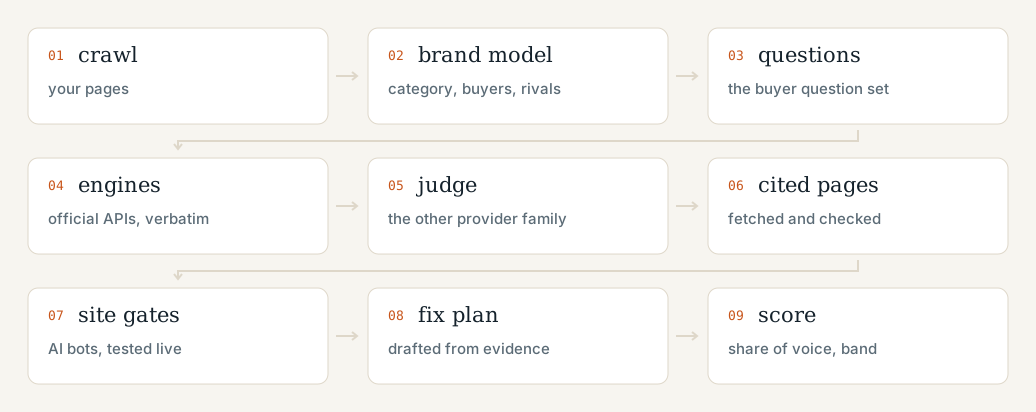
1. Crawl
The homepage and a handful of prioritized internal pages are fetched. Schema types, meta directives, and links are extracted as each page is read, then the raw HTML is dropped - nothing more is kept than the pipeline actually needs downstream.
You see: 01 crawl in the CLI narration, with the elapsed time.
Change it: the crawler's own identity is SAYLENT_USER_AGENT (see
Environment variables) - a self-hosted
deployment should set its own so a site owner can trace the crawler back to
an operator.
2. Brand model
One model call over the top crawled pages builds a structured picture of
the brand: category, ideal customer, products, value propositions, problems
it solves, and detected competitors. Anything you supply yourself
(--brand, --competitors, or a brand edited in the app's onboarding)
overrides what the model would have inferred.
You see: 02 brand model in the narration; saylent questions <domain>
prints the resolved brand model on its own before you commit to a full
audit.
Change it: --brand / --competitors flags, or competitors in
saylent.config.* - see Configuration.
3. Questions
The buyer questions get generated from a fixed template library - 23
templates across seven types (category, comparison, problem, branded,
integration, migration, trust) - filled in with the brand model, then
frozen onto this run. A later verify reuses this exact frozen set,
never a freshly generated one, so before-and-after is always set compared
against the same set.
You see: 03 questions in the narration; the full set, printed, from
saylent questions <domain>.
Change it: questionTemplates in saylent.config.* to change quotas or
phrasings; --questions <file> to hand-supply your own set entirely - see
Configuration and
Extending.
4. Engines
Each configured answer engine (ChatGPT, Claude, Gemini, Perplexity) is asked every question through its official API, with the provider's own web search on - one step per engine, so one provider's outage costs that engine alone, not the whole run. Scored questions get two sampled draws per engine, a third only if the first two disagree.
You see: 04 engines with a live per-engine count
(chatgpt 6/6 claude 6/6) - how many draws were sent, not how many
succeeded, so a provider erroring on every draw still reaches N/N here; a
failed engine gets its own line right after
(gemini 0/8 · 429 rate-limited · continuing with 3 engines) rather than
silently dropping out.
Change it: --engines <a,b> or engines in saylent.config.*.
5. Judge
Presence is decided first, deterministically - a whole-word alias match the judge model cannot override. The qualitative fields (recommended, compared, dismissed, absent; prominence; sentiment) come from a judge model that quotes the deciding sentence before it answers, always from the other provider family than whoever answered (single-family, with a stated caveat, if you only have one key).
You see: 05 judge in the narration; every verdict, with its reasoning,
in the report's Answers section.
Change it: models.judge in saylent.config.*, or saylent models to
see exactly which model is judging which engine right now - see
Configuration.
6. Cited pages
Every page an engine's answer pointed to is aggregated by normalized URL, then the most-cited pages are fetched and checked for brand and competitor presence. A fetch failure reads "unverified," never a guess.
You see: 06 cited pages; the report's battlefield table.
Change it: nothing configurable here today - this stage is pure
aggregation over what stage 4 actually returned.
7. Site gates
Whether the assistants' own crawlers can reach the site: robots.txt per bot class, then a live probe of the same bots (catching a CDN or WAF that overrides robots.txt), plus JSON-LD and meta-directive checks on the crawled pages.
You see: 07 site gates; the same checks, instantly and for $0, from
saylent gate-check <domain>.
Change it: extraBots in saylent.config.* adds bots to the registry;
see Extending to add a whole new check.
8. Fixes
Deterministic diagnosis over everything gathered so far - no model decides what's wrong, only how to phrase the fix once diagnosed. The top-ranked fixes get a drafted, evidence-anchored artifact.
You see: 08 fix plan; the report's Fixes section, ranked.
Change it: thresholds.fixWeights in saylent.config.* re-ranks the
built-in families; see Extending to add
a new one entirely.
9. Score
Scores are computed for the scored question types only, the recommended
band is calculated across the sampled draws, and - on a verify - movement
against the baseline is computed. The result is handed to whatever's
persisting it: the CLI writes run.json / report.html / report.md; the
self-hosted app writes rows and renders the run page.
You see: the final Verdict and Band lines, the report path, the total
elapsed time and cost.
Change it: thresholds.coverage in saylent.config.* for the coverage
gap threshold.
Reading the finished report section by section, rather than watching it get built: Reading a report. The full reasoning behind every choice above - why the full profile takes two draws and smoke takes one, why cross-family judging, what "unverified" means and why it's never guessed: Methodology.